Update · Update
BrewTrak Update: Sharpening the Software, Wiring the Panel, and Learning From Brew Day
BrewTrak has taken a solid step forward. It is now live-tracking the fermentation of a batch of Lamington Porter, and it was also used to track the BrewZilla telemetry on brew day. This recent stretch of work was all…
BrewTrak has taken a solid step forward. It is now live-tracking the fermentation of a batch of Lamington Porter, and it was also used to track the BrewZilla telemetry on brew day.
This recent stretch of work was all about getting the system closer to real brewery use. In the lead-up to brew day, the focus was on tightening up the live brewing experience, improving fermentation data handling, including ingesting some data from the RAPT API, and making sure the advisory AI behaves more like a disciplined brewing assistant than a confident guess machine.
At the same time, progress has continued on the physical side too. One of the big milestones in this phase is that the high-voltage side of the BrewTrak wiring has now been completed. That is a meaningful step toward full panel bring-up and live control integration, and it helps close the gap between the software model and the hardware it is ultimately meant to run.
That milestone means I can now wire up the low-voltage side safely, plug the signal wires into the ESP32 board, and then keep pushing ahead on the firmware. Once that is done, we are ready to test it with a water brew.
A More Practical Brew Day Shape
One of the biggest software shifts has been in how BrewTrak thinks about the brew day itself.
Rather than centring the experience around abstract session concepts, the system has been pushed further toward a batch-first workflow. In practice, that means the batch is becoming the main place where brewing work happens. That sounds like it should have been obvious, but in the overall architecture it can sometimes get lost because of how the system interacts internally. On brew day, the user does not think in terms of software objects. They think about the batch in front of them, what stage it is in, what needs to happen next, and what the process is telling them.
That has now been made much clearer, and real-world use confirmed that the batch record flow is more natural than a separate brew-session-driven interface.
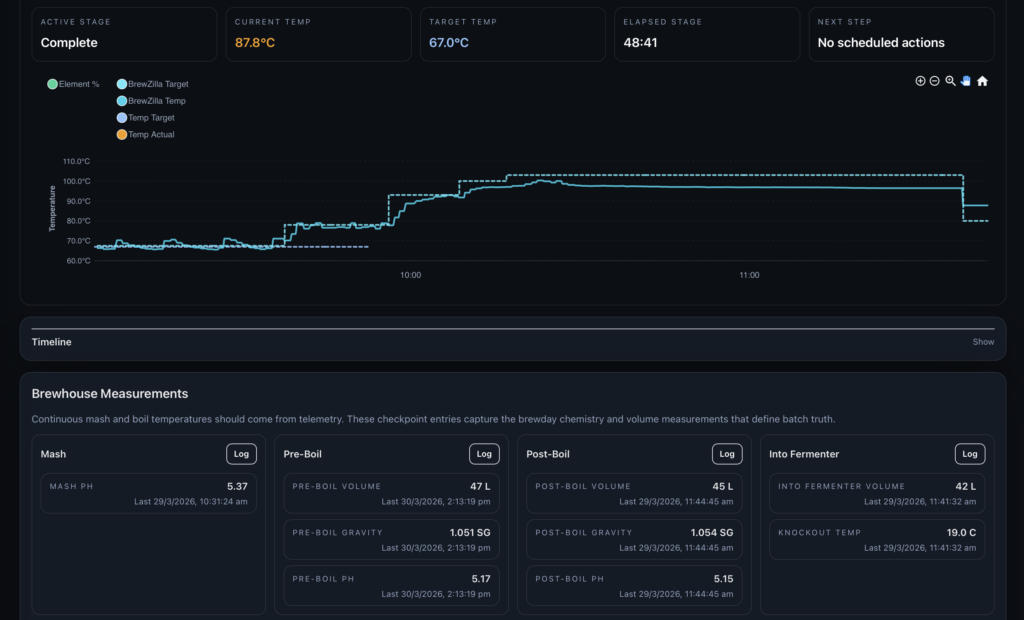
Brewhouse telemetry showing mash steps, pre-boil ramp/hold for sparge and boil
It also highlighted that the live brewing area still needs to become easier to scan, less crowded, and more immediate in how it presents controls and information. The path forward there is now more obvious: key stage controls need to sit directly in the main brewhouse workspace, and the interface needs to feel faster and calmer under real conditions. While it is not the primary focus right now, it definitely needs to happen before I use it solely to manage a brew day.
Brew Day Feedback Actually Matters!
The first live use of BrewTrak as a secondary source of info was valuable for the right reason: it exposed the difference between what looks fine in development and what actually works when you are brewing.
Some of the lessons were straightforward. Layout matters more than expected. Dense screens feel much heavier once they are in front of someone actively working. Charts looked larger than they needed to on laptop-sized screens. Actions that should feel instant still had too much friction.
Mobile use also stood out as a genuine requirement, not a nice extra. If BrewTrak is going to be useful in real brewery conditions, it has to behave properly on a phone. That means modals must always scroll, drawers must dismiss cleanly, and quick actions like checking status, acknowledging something, or logging an event must work without friction.
Those are not cosmetic concerns. They are part of what makes software usable when hands are busy and attention is already split across a live process.
Better Fermentation Data, Better Decisions
A big part of this work also went into making fermentation data more trustworthy.
Support for RAPT telemetry has been improved so the platform can now handle raw gravity values and calibrated gravity values separately, rather than flattening them into a single view of the world.
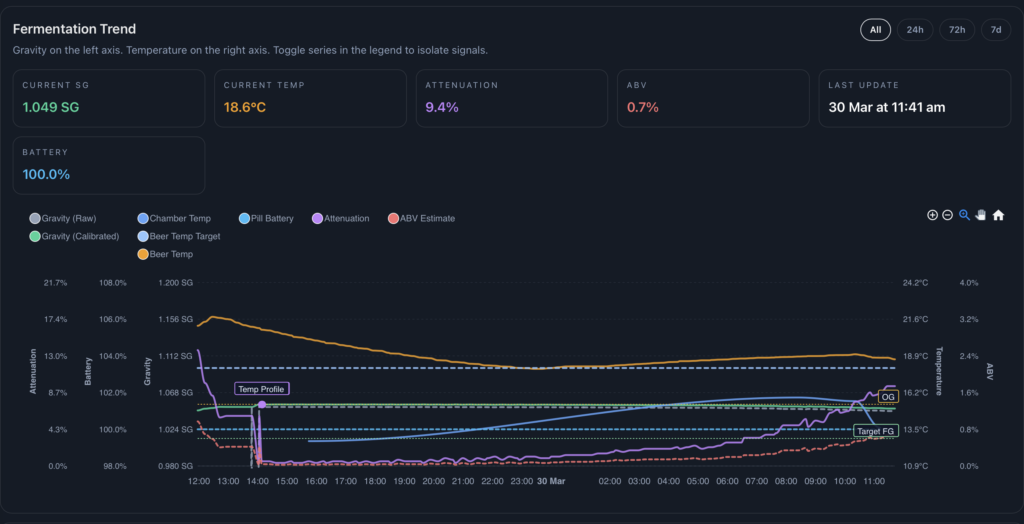
The start of fermentation telemetry coming from the RAPT Pill
Brew day and the work immediately after it also exposed an important issue: some fermentation views and forecasts were being influenced by pre-fermentation telemetry. In other words, the system was sometimes letting “before the real start” bleed into “what is happening now”. That can distort charts, confuse pitch timing, and produce misleading forecast logic.
That behaviour has now been tightened up so fermentation views and forecast logic are driven by the actual fermentation window rather than stray pre-start data. It is one of those changes that may sound small and obvious from the outside, but sometimes you do not see the issue until it is there.
This round of work helped correct that and make the fermentation side of BrewTrak feel much more grounded.
AI, but on a Short Leash
The AI side has also continued to evolve, but with the same principle that has guided it from the start: AI should stay advisory only (at least for now).
That principle has become even clearer after brew day. The useful version of AI in a brewing system is not a magical expert voice pretending to know everything. It is a conservative assistant that works from the data packet in front of it, stays close to evidence, and is honest about uncertainty.
That means no false certainty, no invented causality, and no pretending to know sensory outcomes that the system cannot possibly measure.
The AI review work is now moving in a better direction: looking at telemetry, process execution, recipe intent versus actual results, likely outcome, and practical ideas for iteration. That is much more valuable than generic commentary. It makes the AI layer feel less like a novelty and more like a structured second opinion.
Over time, those reviews will also help build recipe-level intelligence from completed batches, which is where BrewTrak starts becoming more than a live process tool and more of a brewing knowledge system.
What This Phase Really Proved
More than anything, this stretch of work was useful because it clarified the true state of BrewTrak and what I can take away and learn from over the next week in preparation for the next brew day.
I’ll have a video of the Lamington Porter up on the channel soon, so make sure you check it out.
Cheers!