Update · Update
BrewTrak Update: From Brew Day Tool to Brewery Platform
Since the last update, BrewTrak has kept growing from a brew day controller and fermentation tracker into something much broader. The clearest change is that the system now has a stronger shape around how a brewery…
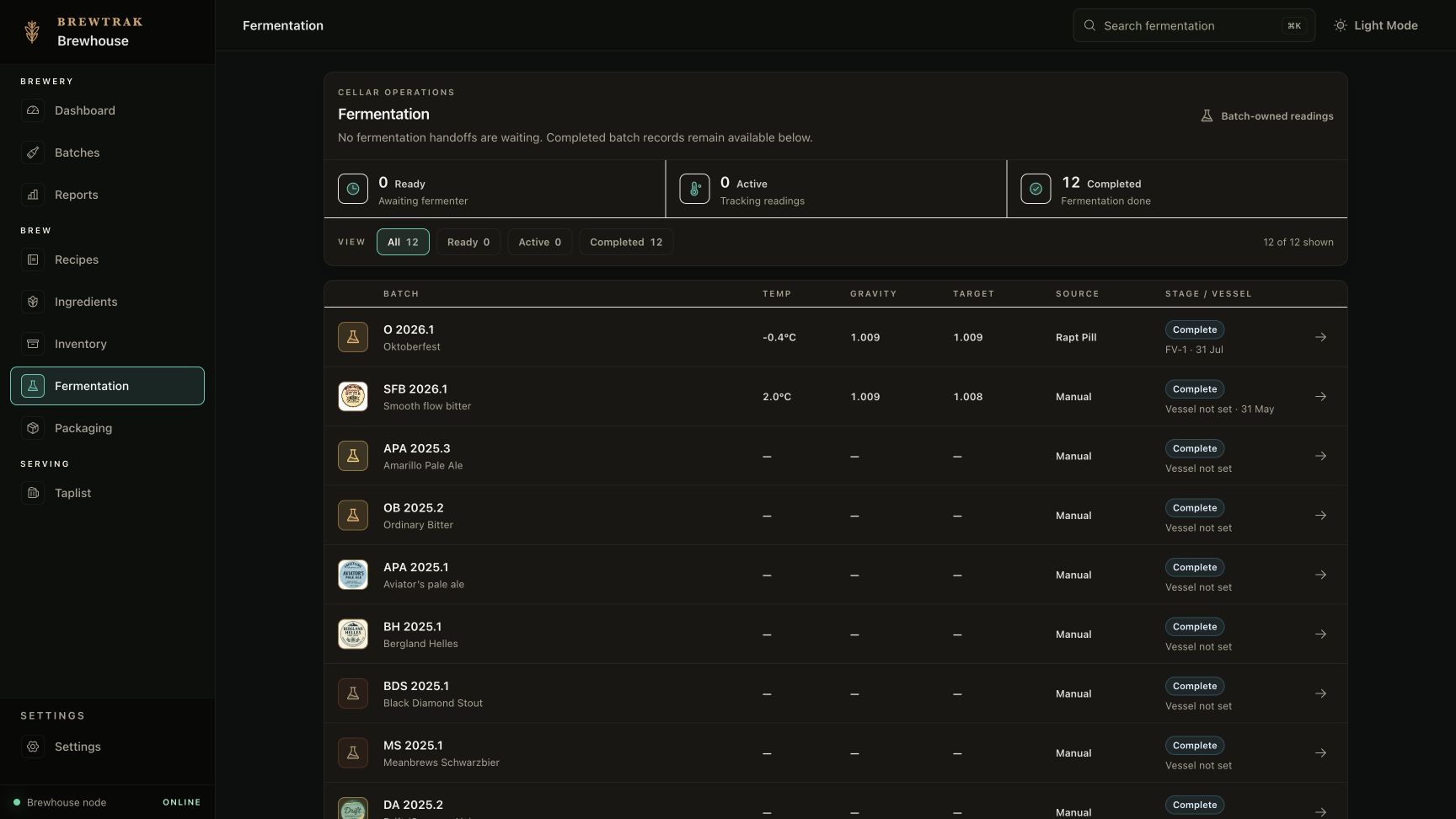
Since the last update, BrewTrak has kept growing from a brew day controller and fermentation tracker into something much broader.
The clearest change is that the system now has a stronger shape around how a brewery actually works. Recipes define what I’m trying to make. Batches become the production record. Brew sessions handle the live brewhouse run. Finished inventory then carries the beer through packaging, serving, and taplist workflows.
That might sound obvious, but getting those pieces to behave and link together has been a big step forward.
A lot of the recent work has gone into strengthening recipes and batches, adding styles and ensuring user experience matches the purpose of the actions.
Recipes now support audit history, revision checkpoints, BeerXML import, recipe logos, mash profile selection, mash-step snapshots, and checks against available inventory. Mash profiles can also be copied into a recipe and adjusted there without changing the default profile, which makes it much safer to fine-tune a process for a specific recipe.
Batches have grown even more. They now carry the real production story: identity, lifecycle state, recipe snapshots, fermentation setup, QA and release notes, brewhouse measurements, and packaged inventory.
Fermentation now belongs properly to the batch rather than being treated as part of the live brew session, which makes much more sense once the wort has left the brewhouse. That area now supports charting, samples, process steps, held-wort handling, and RAPT integration work.
Inventory has also become more practical. BrewTrak now separates ingredients from finished beer, supports stock movements and transfers.
I’ve added imports from Brewfather inventory and batches to bring historic context for the “intelligence” layer, and can connect recipe planning back to what is actually on hand in terms of ingredients. I have implemented the filter for what I can brew with ingredients in stock, as well as what likely substitutes are from other stock on hand.
Packaging and serving are starting to take shape too. There is now support for wort kit batches (brewing from a kit), soft drink batches, finished beer inventory views, taplist setup, and a more display-ready tap board ready for keg volume tracking.
Reporting has also started to come together, with date filters and batch volume reporting now in place. That gives BrewTrak a clearer path toward production dashboards, review tools, and eventually costing.
So, in short, BrewTrak is now well beyond basic brew day logging.
It is becoming a connected brewery platform for recipe design, batch execution, fermentation tracking, inventory, packaging, taplist display, and production reporting.
Current Focus
The next stage is refinement.
I’m working on making ingredient identity smarter for real brewery use, especially hops, where harvest year and alpha acid percentage matter. I’m also continuing to harden the import flows and polish the production workflows so BrewTrak feels fast, reliable, and natural to use during actual brewing.
The biggest shift is that BrewTrak is starting to feel less like a collection of useful brewing tools and more like one connected system. There is still plenty to tighten, but the shape of it is becoming much clearer.
More soon.